Le Gruyère AOP
Le Gruyère AOP
Overview
Le Gruyère AOP is a traditional raw milk cheese with an unmistakable taste and of unique quality. Is is a natural product. Cheese lovers from across the world love Le Gruyère AOP with its strong, mature flavour – it is a masterpiece of Swiss cheesemaking. The product is filled with emotions and created by people.
Le Gruyère AOP
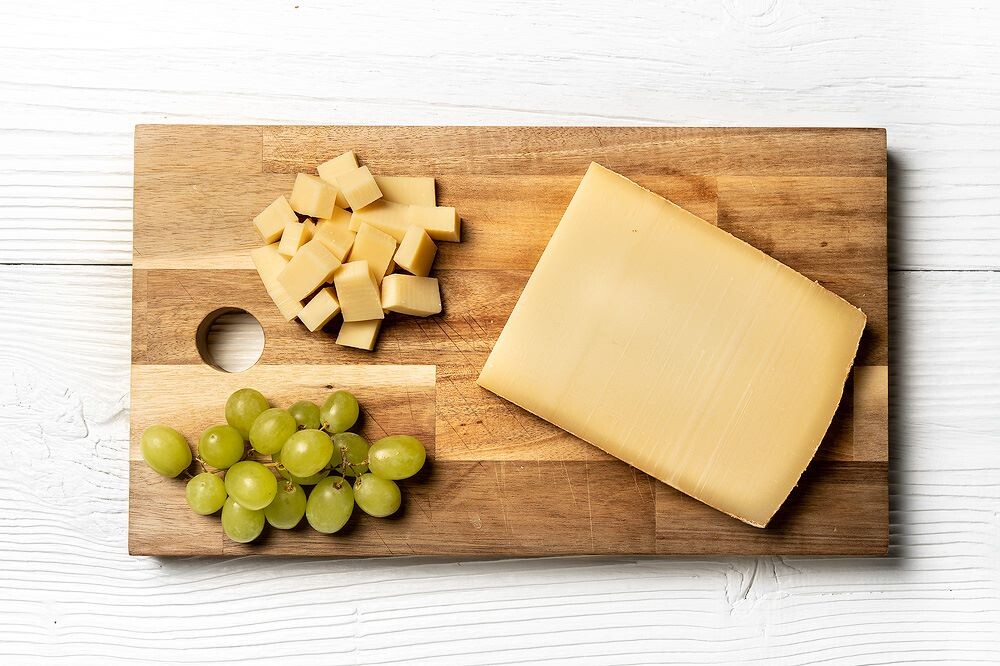
Paste: feels slightly moist. It is supple, medium-firm and a little fragile. Its uniform ivory color varies according to the season.
Taste: salty basic tone, fruity flavors dominate, which arise from the interaction between lactic acid fermentation and lube
Texture: the cheese is smooth to the touch with a slightly damp feel. It is soft, moderately firm and not very crumbly. Its solid ivory color varies according to the season.
Appearance: round loaf with lubricated, grainy, uniformly brownish and healthy rind. It must have a normal size and be well proportioned. The outer edge, which is called the “heel”, is slightly convex.
Maturation: from 5 to 18 months
Milk: fresh raw milk
Origin
Le Gruyère AOP owes its name to the region of Gruyère, in the canton of Fribourg, in Switzerland. It has been produced according to the same traditional recipe since 1115. Nowadays, it is made in the cantons of Fribourg, Vaud, Neuchâtel, and Jura, and in a few municipalities of the canton of Bern.
History
The production of cheese in the region can be traced back to 1115. It continues nowadays according to a well-tried recipe in the village cheese dairies of its native land – the district of La Gruyère in the Canton of Fribourg (Switzerland) – but also in the cantons of Vaud, Neuchâtel, and Jura, as well as in a few municipalities of Bern.
The region of Gruyère has been known for its cheese production since the 12th century. Medieval chronicles also mention the expertise of its inhabitants, who turned the milk production of their herds into full fat cheese. This product was even sold in France and Italy.
The 17th century marked an important stage in the history of Le Gruyère AOP as it coincided not only with the official recognition of its name, but also with a real boom in exports. During this time, the first measures for the protection of its origin through marking came into play. The word specifying its origin entered the dictionary of the Académie Française (1762).
A high emigration level which hit Fribourg during the 18th and 19th century. It extended the geographic production zone of Gruyère cheese to the cantons of Vaud, Neuchâtel and Jura, as well as to neighboring France. However, with no trade protection and with its quality as only means of defense, Le Gruyère AOP was often imitated. As early as the mid-19th century began a campaign towards structuring the trade as well as a fight for a recognized designation of origin.
Maturation time
The Le Gruyère AOP is also a question of taste.
Between 6 and 9 months, its soft and refined taste will delight palates in search of sweet pleasures. It is called “Classic”.
Starting at 10 months, Le Gruyère AOP Réserve has a full-flavored and aromatic taste, which will please lovers of aromatic subtlety.
Some wheels will be matured up to 18, or even 24 months for lovers of strong sensations.
Whatever the age of the Le Gruyère AOP you are savoring, its qualities remain the same!
Production
The cows which produce milk for Le Gruyère AOP are solely fed on natural forage—fresh grass in summer and hay in winter, with no additives or ensilage. Twice a day, in the morning and in the evening, each milk producer delivers this precious ingredient to its assigned cheese dairy. The morning milk is merged in the copper vat with the evening milk, which was left to settle all night. The cheese-maker adds starter cultures, made from whey, to mature the milk. Then he adds rennet, a natural ingredient extracted from calf stomach, to curdle the milk. After 35 to 40 minutes, the vat has turned into a nice dense mass. As the milk was not heated before the curdling, it maintains all of its aromas. It is one of the qualities of raw milk. This curd mass is then cut into granules by big knives called “cheese harps” (tranche-caillé). Then the contents of the vats are gradually heated up to 57° (135°F) for 40-45 minutes. Once the heating temperature is reached and the granules are the size of wheat grains, the cheese-maker takes a handful of grains and carefully kneads them into a mass to check the texture.
The contents of the vat (grainy curd and whey) are then pumped out into round molds. Each mold is marked on its outer edge (which is called the “heel”) with the inscription Le Gruyère AOP, along with the number of the cheese dairy. The whey runs out and is collected in a large basin underneath. A casein marking is added to the whitish curd mass, indicating the number of the cheese wheel and of the cheese dairy. Furthermore, the manufacturing date is added to each cheese wheel. Casein is a natural protein found in milk: still no additives. Each wheel is then pressed for about twenty hours, with an applied force of up to 900 kg.
The following day, the cheese-maker removes each wheel from the mold and puts them in a 22% concentrated salt bath, also called brine, for 24 hours. Then begins the maturation. The wheels are stored for three months in the cheese-maker’s cellar. He will give them almost daily care, in order to help the formation of a fine protective rind (called “smear”–morge).
After three months, the wheels leave the cheese dairy to be stored in the caves d’affinage (maturing cellars) for a slow maturation process in a 90% humidity environment and a temperature of 15° (59°F). During this time, the wheels are turned over and brushed with salt water. The cellars give off a typical smell of ammonia, a result of the maturation of the wheels. The affinage lasts in total between 5 and 18 months.
At four months, the wheels are checked and taxed by experts of the Interprofession du Gruyère association, according to very precise and rigorous criteria. They can display the name Le Gruyère AOP only after this taxation. As always, quality is the key word. As soon as they reach 5 months, the wheels are put on the market by the affineur (maturer).